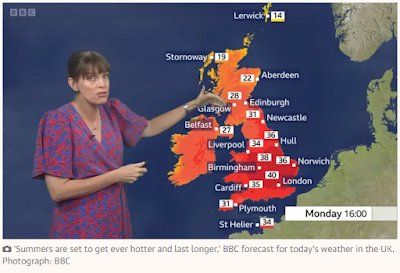
Friday, 30 September 2022

Methane and Climate Change – What Does The Science Say?

In the media there has been a lot about methane from cows being a growing danger because of its contribution to global overheating and climate change. There has been huge expenditure, measuring how much methane cows burp, and whether feeding them seaweed reduces methane emissions.

It’s an understandable concern, because methane is a far stronger greenhouse gas than carbon dioxide. Also methane has been highlighted as a problem in the latest UN IPCC Assessment Report. But what do actual measurements of atmospheric methane tell me? More graphs now. – I’m all about graphs!

From NOAA (National Oceanic and Atmospheric Administration)

The above graph stacks the Greenhouse Radiative Forcing (what humans have caused) from all the different long lasting greenhouse gases. It looks like they are all rising, but this is deceptive. The following graph takes the same data, but splits each gas into its own separate line.

CO2 is Carbon Dioxide, CH4 is Methane

I think this shows more clearly that warming from methane is hardly increasing at all. The villain of the piece is carbon dioxide, the only greenhouse gas that is rapidly increasing in the amount of warming it does.

So why all the media concentration on methane and cows? And why emphasis methane in the IPCC AR6? I think that the BBC series Big Oil vs The World tells us. Methane is clearly yet another diversion from Big Oil. They did after all get rid of the UN IPCC authors of AR5. Big Oil funded favourable politicians to power in the USA, who successfully lobbied to replace the IPCC scientists Big Oil didn’t like. This explains why AR6 overemphasises the importance of methane.

The danger of methane released by the melting of permafrost in a feedback loop is a different and real issue. And one more reason to start climbing down this dangerous ladder we are climbing.


Wednesday, 28 September 2022

Net Zero Carbon and Zero Carbon - What’s the difference?

 Net Zero Carbon and Zero Carbon

–        What’s the difference?

–        Does it matter?

–        Is there a better way?

Of course it matters, because these are wildly different things, with hugely different consequences.

Net Zero Carbon is the aim of many countries, who following COP26 are saying that their collective individual efforts will meet the aims of the Paris Agreement, to keep global overheating below +2°C and hopefully below +1.5°C.

There are a number of different problems about each country managing their own efforts with no overall binding global plan, and the option to drop out like Trump did. But the main problem is that even if everything goes as hoped, the world remains in a dangerously overheated state: temperatures never drop back down again. Net Zero means that CO₂ (Carbon Dioxide) emissions balance sequestration: additions balance subtractions. So CO₂ levels remain high, keeping temperatures high. It’s like climbing a poorly supported ladder that is only just in balance. The higher you climb, the more dangerous it is, and the more likely disaster is to happen. The safe thing to do is climb back down the ladder. But with Net Zero Carbon we stay balanced high on the ladder. Zero Carbon means we climb back down the ladder, to the very bottom and stay safe.

These three graphs from my Climate Model illustrate the global situation. Note the difference between the 2050 deadline that most have agreed, and the 2060 deadline which China has said they will follow.

Graph of Net Zero Carbon by 2050


Graph of Net Zero Carbon by 2060

Graph of Zero Carbon

As can be seen, the delay of just ten years pushes the temperature increase above +2°C. Also it takes a very long time to get to Zero Carbon, even reducing emissions by 5% of the previous year each time. In fact because this is an exponential progress we never get to zero, just closer. But Zero Carbon does bring the temperature back down again.

Don’t take these graphs as being set in stone, they are illustrative, like all models. In reality, achieving a uniform reduction in the real world, with each country doing its own thing, is nearly impossible under the COP26 agreement rules.

There is another problem with the Zero Carbon approach. Is it realistic to expect a complete switch away from fossil fuels? Is it even necessary? My final graph suggests that as far as bringing temperatures back down to a safe level goes, there is a safe middle way which still allows some use of fossil fuels.

Reducing to 25% of Carbon

This doesn't reduce temperatures as quickly as with Zero Carbon. Also temperatures still go above +2°C. But that can be changed by reducing carbon more quickly as follows.

Reducing to 25% of Carbon More Quickly

A better, more certain way, of ensuring carbon emission limits are achieved is required, but that I have already outlined in Pages on this Blog.


Wednesday, 24 August 2022


The Cliff Edge at Beachy Head – Climate Tipping Points


My grandparents used to live nearby, so as a child I often visited the cliff at Beachy Head, going just close enough to look over the edge at the lighthouse so far below. As an innocent child I didn’t know that this was also an infamous spot for suicides.

This cliff edge is a perfect analogy to the dangers of climate tipping points. We are on a suicidal rush of increasing fossil fuel consumption, which is driving us at full speed towards a cliff. Our top scientists have been telling us for decades that we have to stay at a safe distance from the cliff. But those same scientists can’t tell us what a safe distance is – because they can’t know.

Do you see that piece of cliff where the grass is like a lower ledge? That is where the cliff has started to crumble. I remember those ledges and wanting to climb down onto them. My grandparents wouldn’t let me. My weight was small back then and I might have been safe, but my grandparents, being wiser, said to stay away from it. Climate tipping points are like that ledge. If they are crossed and fail, they will go quickly and catastrophically. Which is why we need to stay away from them by a safe distance. No one can predict when that ledge will collapse – because we can’t know.

Edit: I should have made it clearer that the higher temperatures get, the closer we are to edge. Net Zero means that we stay balancing along the very edge, halted at the highest temperature rise, jumping up and down on the ledges. Only Net Negative takes us further away from the edge and to safe and stable ground.


Wednesday, 17 August 2022

From: Big Oil CEO

To: Media Shaping Team

Climate Change Strategy – Strictly Secret – NDA Required Before Reading

Our industry faces an existential threat. Our fossil fuel extraction projects face being shut down or at least limited to a small percentage of current output. This will have a serious impact on our profits and so must be countered at all costs.

To investigate the impact on the world of burning increasing levels of fossil fuels we have hired some of the top scientists, (all have signed NDAs). The news is bad. Increasing levels of carbon dioxide and methane will increase world average temperatures because of the greenhouse properties of these gases. This will change the climate of the world to be more chaotic, with longer and more frequent droughts, but also heavier infrequent rain causing flooding.

The good news is that these changes will happen slowly, so most people won’t notice. But eventually people will be so disturbed by the destruction of their homes by wildfires and food shortages causing starvation that politicians will be forced to act. Your task is to delay the inevitable measures for as long as possible so that business can continue as usual.

Delay – The overall strategy is to delay and postpone control measures: so we need to detail exactly what we most fear as an effective plan and so must stop happening. The most effective way of countering and reversing climate change will be to globally ration the extraction of fossil fuels down to well below the level of carbon naturally sequestered by absorption in oceans and land. The following steps will be followed to delay this happening.

Denial – Following the example of the tobacco industry the first obvious step is to deny that anything bad is happening. We have more money than our opponents and can fund research to confirm that everything is normal. The climate is easily confused with the weather by most people, and weather is far more variable than the initial climate changes, so this is an easy first step.

Doubt – The scientific evidence will grow that global heating is happening and even linked to climate changing. But although people think science is a certainty, our advisors tell us that there is always a level of uncertainty. This can be played on to cast doubt. Small discrepancies can be cherry-picked and used to cast doubt on all the science. We just need to shout loudest. Hurricane frequency is a good example of where particular geographical locations and time periods can be chosen to show nothing is changing.

Democracy – Politicians will be bought. Many have big fossil fuel industries in their constituencies and will support keeping those jobs and those votes without funding from us, but pay them anyway, to keep our options open. Note here that coal constituencies are most vulnerable to us because coal is the worst fossil fuel and the first to be rationed out of existence if we fail. In the USA we are lucky that the system is so easily rigged. We have successfully supported the candidates in primaries we prefer, which nearly always got them selected and elected. Political influence will also give us lobbying power which will enable us to shape even the personnel of the IPCC.

Duplicity – Don’t worry. No one cares about truth anymore. Alternative facts are all the rage, and you will use them prolifically. Shower the world with so many facts that no one will be able to tell truth from fiction. Now that we have replaced the difficult scientists writing IPCC reports with our own choices this is working well. AR5 contained dangerously available and visible information. AR6 is far more opaque and cluttered so that only specialists will see anything that might harm our cause. World leaders will be kept well in the dark.

Diversion – There are so many ways that we will divert attention, mostly covered below under disinformation, but the main thing is to shift the attention away from fossil fuel companies and our products. This is best done by concentrating on emissions. Since the greenhouse effect is caused by emitted gases, it’s easy to focus attention on emissions and the emitters. This nicely shifts the blame away from us suppliers to the consumers. Since there are billions of consumers who mostly cause emissions indirectly by everyday activities and purchases this will be an extremely effective strategy. The probability of the majority of individuals feeling guilty enough to change their purchasing choices to eliminate fossil fuels is vanishingly small and no real threat. And anyway the production and supply chain for all products is so scattered with fossil fuel use that individuals can’t have that choice. So always talk about emissions, never extraction. The Paris Agreement is an excellent example of this, where although greenhouse gases are mentioned there is not a single mention of fossil fuel, coal, oil or gas.

Division – Exploit it. Encourage it. We are stronger than the liberal greens because we have a united purpose – profit – and far more money than them. They have multiple organisations competing against each other for funding and supporters. Keep it that way, divided. Even encourage new organisations and groups so as to increase their division. Nations should also be kept divided. Nations naturally compete against each other and their governments are only interested in national advantage. This made it easy for us to ensure that every nation signing up to COP agreements decides their own targets and timescales, and that they can easily be reversed. No country will willingly let another gain economic advantage. This has been well exploited to ensure that no country will cut fossil fuel consumption faster than their competitors. Net Zero Carbon by 2060 for China has got many to question why their target dates are sooner. I expect many to change to 2060.

Deception – Net Zero Carbon was well done. It sounds like effective action but we know it means business as usual. We held off the danger of Net Negative Carbon very well. The unattainable CCS technology being held up as the Net Zero balancing force also plays into the general delay strategy. Keep on the good work of hiding the knowledge that about half our emissions are naturally sequestered. If that was well understood, and that Net Negative Carbon was easily achievable, we would be in serious trouble and extreme NDA sanctions will be applied to those who fail me.

Doomism – As things get worse and worse, as temperatures keep on rising, as droughts become more frequent and prolonged, as wildfires become more destructive, as floods become deeper and stronger, as food production fails and millions starve, many will give up. We will encourage this, since this sector of the population is no threat to us, and will even resist those who think they can defeat us and reverse climate change by limiting fossil fuels.

Disinformation – This is a very rich field of possibilities, closely linked to Diversion above. Social media opens opportunities to spread disinformation because there are very few checks. But even the conventional media will publish disinformation. Not only will the media we have direct influence over publish our version of information, media that might seem hostile to us is run by journalists with no scientific background – they are nearly innumerate. They are incapable of telling our misinformation from the truth and so will publish it, if we disguise the source, enough for it to look legitimate.

-------------

While a satirical work of fiction, this also holds facts and well researched frauds. So how much is fiction?
https://www.bbc.co.uk/iplayer/episodes/p0cgql8f/big-oil-v-the-world

Thursday, 21 July 2022

Record UK Heatwave

The UK just had a record breaking heatwave, and the future predictions are for worse.


But surely the Paris Agreement and the 26th COP agreement will save us all? 😉

There are a few problems with COP26; nation is pitted against nation in order to keep using fossil fuels as long as possible to preserve their economy - (China wins with a 2060 target), Net Zero Carbon fixes CO2 levels at a new overheated level when they need to reduce, and money for the climate crippled countries hasn't appeared.

My Reversing Climate Change scheme addresses all these weaknesses. 

Can you think up a better one?

Tuesday, 7 June 2022

 Bonn Climate Change Conference

Truth, Lies and Catastrophe

Everybody lies: mostly to themselves.

The truth is out there, but it’s terrifying.

We all know that we are mortal and doomed to die. But every day we hide that truth from ourselves in order to see tomorrow. This habit, of hiding from tomorrow’s truth, is necessary for continued survival, but is now killing our planet.

I was going to include a mass of hyperlinks and references to the locations of where I’ve found the truth, but with the internet being available to nearly everyone, that is not necessary. And anyway, verification of truth is a necessary skill in the modern world. The internet is peppered with truth and lies. Distinguishing between them is difficult: but if we are to grow up and leave childhood’s “Trust Daddy” behind us, that’s a skill we must learn.

I like life, and want to see as much of it as possible. Intelligent life on our planet is unique in our galaxy. That’s the implication of the Fermi paradox. It could continue for another billion years if James Lovelock’s guesstimate is right. We are on a path that will eliminate all life from this planet within a few hundred years, but we can change direction if we look the truth of catastrophe squarely in the face.

How do I decide what’s true? Science helps me. As I write this I’ve a trail camera taking video clips of everything that visits the birdbath in my garden. I’ve been doing this every month for the past year and recording every visit in a spreadsheet. This is data that tells me not just which bird species visit but which just come for a drink and which actually bathe. Why do I do this? Well, as well as being a long time birdwatcher, I’m trained in using data scientifically.

People tend to think that science is fixed: full of facts set in concrete. But the great thing about science is that it’s always questioning old beliefs in order to find new truths.

Even great scientists like Einstein get things wrong. He believed that the universe had always existed and so added a fudge factor to his relativity equations to make it so. When the big bang beginning of the universe was discovered he said this was the biggest mistake of his life.

James Hansen is known for his vital testimony about climate change in 1988 and his activism for mitigating global warming. He is cited as claiming that if carbon dioxide levels are reduced to 350 ppm climate change will be stabilised. This would be returning levels to those of 1990. I checked this out by looking at the history of ice melting in Greenland, Antarctica and the Arctic. The graphs tell me that drastic melting started just before 1980, when levels were about 340 ppm. The graphs also tell me that true stability started breaking down after 1900 when levels rose from the pre-industrial levels of 280 ppm to 300 ppm. So where do our current levels above 420 ppm actually need to drop to? Who’s telling the truth?

Everywhere I look at climate change information I detect the fell hand of fossil fuel lobbying manipulation. Even the terms climate change and global warming have been chosen to seem unthreatening. Change could be good or bad. Warming seems harmless, even desirable in the cold northern climes where most decision makers live. If the more realistic terms of climate chaos and global overheating had been used would we now be acting differently? Or what if climate catastrophe and global burning were the terms in use? It is now known that fossil fuel lobbying even determined the very name of the Intergovernmental Panel on Climate Change (IPCC).

Our current hope of containing climate change is invested solely in the Paris Agreement. We know that the driver of climate change is the burning of fossil fuels. Search the text of the Paris Agreement and the following words are missing; fossil, fuel, coal, oil and gas. The agreement only targets emissions, never extraction: which is inefficient, being too late in the process. No wonder there has been absolutely no change in the trend of increasing carbon dioxide and overheating.

Net Zero Carbon by 2050 is the target set by the UK. This is obviously the wrong target. If there is already too much carbon dioxide in the atmosphere, and it keeps on increasing, we need Net Negative Carbon – and globally.

Denial, Distraction and Delay. Fossil fuel lobbyists have mostly given up denying that burning fossil fuels is causing climate change. But they are still doing what they can to delay the necessary changes that will limit their carbon throughput. It seems that the current strategy is to distract with misinformation and misdirection. Hence no mention of fossil fuels in the Paris Agreement and a Net Zero Carbon target instead of the Net Negative Carbon required. We also see schemes such as tree planting promoted, even though they have no hope of sequestering enough carbon to offset fossil fuels.

Why do fossil fuel companies keep on lobbying for measures that will destroy us? They are not necessarily evil or mad people bent on destruction: they have no choice. Directors have to maximise short-term profits and keep share prices high. When BP tried a Beyond Petroleum strategy of switching investment away from exploration for new fossil fuel reserves to investment in renewables the share price plummeted and they did a rapid U-turn. They are trapped by market forces on this road to destruction.

Methane is another increasing greenhouse gas hitting the headlines, but with misinformation about it being caused by cattle. At worst about a quarter of methane emissions are caused by agriculture, a lot of which is from cattle, but at least half of methane emissions are caused by fossil fuel extraction, either directly or by leakage.

How bad will it get? The true answer is that nobody knows for sure. The relationship between increasing carbon dioxide and increasing heat is well known and predictable because it is a linear relationship. The difficulty comes with trying to predict the effect of numerous feedbacks which are not linear. As an example: increasing temperatures melt more arctic ice which exposes more sea to warming, which melts more ice. This is an exponential relationship like all feedbacks and so is difficult to predict. And the elephant in the room that no one mentions is increasing atmospheric moisture forming clouds. Clouds are by far the biggest greenhouse factor: without them Earth would freeze solid, as would Venus. This is where the Venus effect becomes important. In the early days of our solar system both Mars and Venus were water worlds like Earth. Mars was too small to hold on to its atmosphere and so froze. Venus developed so much cloud that the greenhouse effect boiled all the water and has now created a lifeless planet with a surface temperature hot enough to melt lead. This is the path we are on if we continue unconstrained fossil fuel extraction: total extinction of all life on Earth and hence in our galaxy.

I don’t want catastrophe to happen. I’ve been a conservationist for ages. So how can we stop it happening? The obvious first step is to limit fossil fuel extraction. If that isn’t done, then the only other path to survival is geoengineering. Geoengineering is the desperation last hope.

Aren’t we already limiting fossil fuel extraction by limiting emissions? No, this is another lie. Fossil fuel extraction has continued virtually unchanged, and so have emissions. It might seem a logical thing concentrate on limiting emissions, and country by country, but it is bound to fail because it is too little, too late in the process. There are too many loopholes, such as exporting emissions to a different country. Only a global solution can fix our global problem, and only by focussing on the production of fossil fuels can we realistically control carbon. We’ve done it before under the Montreal Protocol to phase out the manufacture of CFCs and so we saved the ozone layer. That hole in the ozone layer is nearly mended already.


Do people check out facts to find the truth? Well I’ve included a deliberate falsehood above. Can you spot it?


Tuesday, 22 February 2022


Our Climate Change Cul-de-sac

or The Wrong Trouser Leg

When I contemplate just how ineffective the COP26 agreement is, it seems the world is still driving at full speed down a climate change cul-de-sac towards a terminating brick wall. The major participating countries with their independent plans have a wide variety of agreed targets and timescales for net zero carbon emissions, none of which are adequate. But of course they are inadequate. Any country that agreed to an adequate plan would be at an economic disadvantage to the others. Worse than that, any country on a change of government can change the plan or even do a complete U-turn. The global warming problem doesn’t have a global solution for the global problem and so is bound to fail.

I’m reminded of Terry Pratchett’s book Jingo and the trousers of time. The hero Sam Vimes makes the right decision, chooses the right trouser leg and saves the day, but he is kept in touch with the disaster that happens in the alternate universe where he made the wrong decision and took the wrong trouser leg of time. I feel like I’m in the wrong trouser leg in this multiverse and I want to change legs.

So what’s happening in the right trouser leg of time where good decisions were made?

Firstly it was agreed that a global plan was needed with a global limit on carbon emissions that reduces year by year to sustainable levels. At first this carbon ration starts at current levels and reduces slowly since this change is going to be difficult to adjust to. Then the rate of reduction speeds up as everyone adapts to a lower but totally predictable level of carbon ration.

Secondly it was recognised that the place to control carbon emissions from fossil fuels is at the beginning of the supply chain from producer to consumer. The complex network of fossil fuel extraction and distribution has so many branches that it is nearly impossible to control at the point of emission. Just think of all the gas that is flared from oil wells. It’s far more efficient to include all carbon at the point of extraction.

So now we have the idea of a global ration for carbon extraction from the geology of our planet. And the extraction of carbon by fossil fuel organisations is limited by that ration. But how is the ration distributed fairly? In my vision it is decided that every person on the planet has an equal right to a fair share. For practical reasons the carbon extraction ration is actually distributed free to every country in proportion to their population. This ration is then sold on a global market so that every fossil fuel extracting organisation can buy the quantity of ration they need to match extracted carbon. No one is allowed to extract geological carbon without adequate ration. This ration is controlled with block chain computing and is open to all to see and is part of the audit process for all fossil fuel extraction organisations.

Countries, especially developing low carbon countries, get a lot of revenue from this system and the world becomes a more equitable and stable place with fewer wars and refugees.

Because countries do not control the carbon emission plans, just the way they adjust by switching to non-carbon energy sources, it is impossible for countries to mess up the system. Countries are responsible for regulating and monitoring any fossil fuel extracting organisations based on their soil, and any disputes are settled by an independent dispute settlement system as with most trade agreements.

There is also a parallel but completely separate system for rationing organic carbon extraction. This is to control carbon extracted by forest clearance, peat extraction and similar activities. The reason they are separated is to allow for carbon sequestration either geologically or organically. This is needed because organic sequestration of carbon in the short-term carbon cycle is so fragile that the possibility of the carbon being released suddenly by sequestration woodland burning down needs to be catered for.

The final important item is that the right leg of the trousers has a net negative carbon target instead of net zero carbon. This is because we are starting with an atmosphere that already has far too much carbon in it, and so is way out of balance. And that imbalance is getting worse all the time. Net zero sounds great, balanced, a “what goes up must come down” situation, but it’s not going to fix the imbalance, only net negative carbon will put things back like they were. But the good news is that because the balance of carbon in our atmosphere is so badly out, about half of the excess carbon we emit is naturally sequestered by natural process on land and sea. So the sustainable levels target of carbon extraction for the next few decades turns out to be between 10% and 25% of current levels if we want to keep below +2°C of global warming. 10% of current levels could even keep us close to +1.5°C.

If only I could somehow get into that right trouser leg of time. Well just maybe we can back out of this cul-de-sac and take a better path.